Listening to product stories
Proposed qualitative interviews with approximately 12–15 adult household participants, discussing specific electronic products.
Postgraduate Sustainability Research · Norfolk, UK
Ridding Practices and Responsibility Boundaries in Household Electronic Goods

Understanding the journey beyond ownership.
Exploring what happens to the electronic products we no longer use, and where responsibility continues, changes or ends.
What happens to the electronic products we no longer use?
When a mobile phone is replaced, a laptop stops working or a tablet is put away, where does our responsibility for that product begin, change or end?
Electronic products often retain functional, material or economic value long after their owners stop using them. Some are repaired or kept as spare devices. Others are stored, sold, donated, passed on to family members, recycled or discarded.
These journeys are shaped by more than individual environmental attitudes. Household routines, financial circumstances, social relationships, practical knowledge, product design and access to services all matter.
02 / Many possible futures
Everyday use changes. The journey continues.
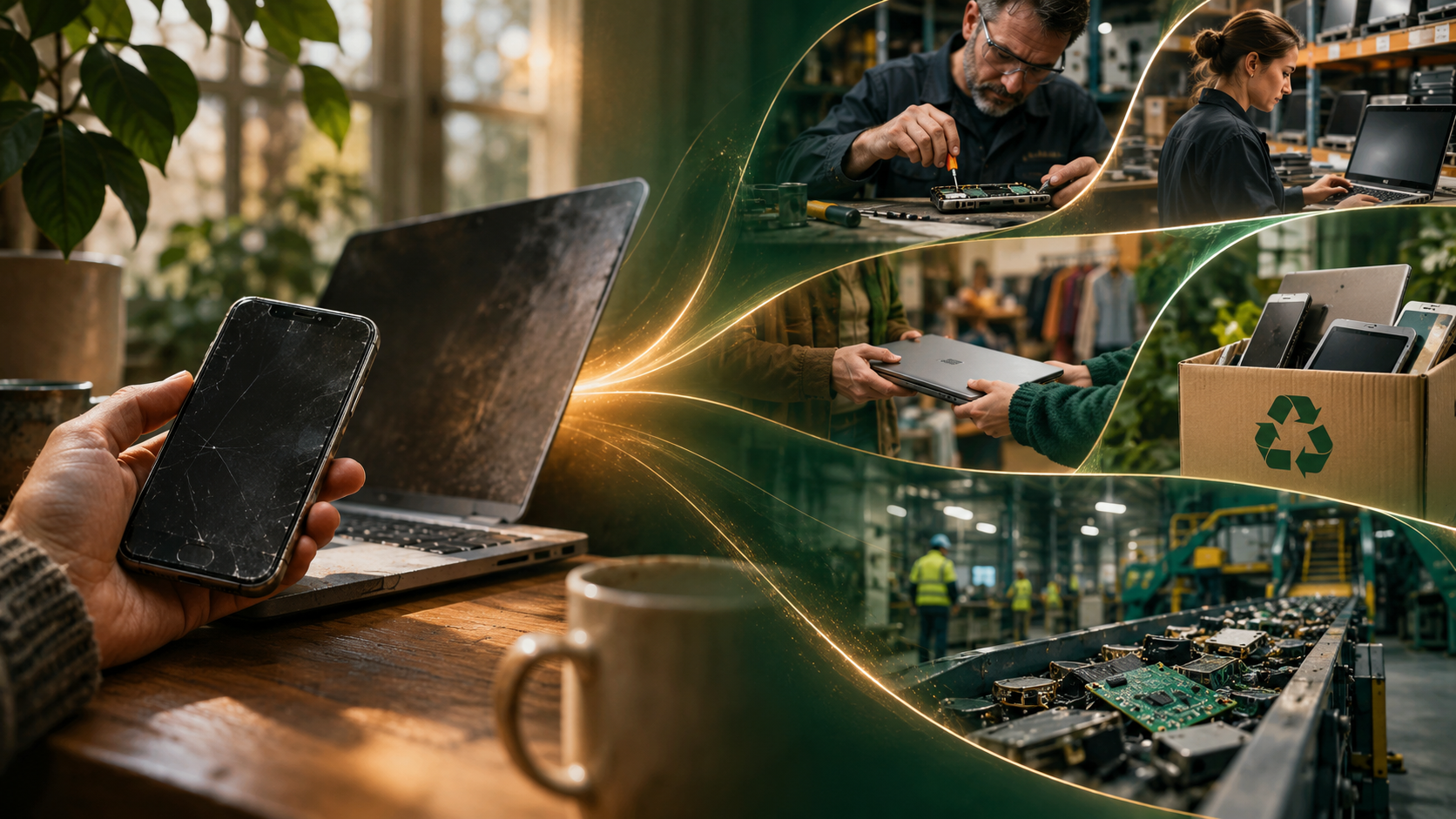
Products can take different, interconnected routes. A stored device might later be repaired, donated, sold or recycled. At what point does responsibility change?
Mobile phone · Household storage
A stored device may retain personal meaning, information or future usefulness. Storage is not necessarily the final stage of its journey.
Possible onward connectionsIllustrative conceptual model — not a research finding or a verified representation of actual material flows. Choices are not collected or stored.
03 / Connected perspectives
The study asks where responsibility continues, where it is shared, where it is handed over and where its boundaries become uncertain.
Understanding how everyday activities are shaped by meanings, competencies, materials, routines and infrastructures.
Practices connect what people know and value with products, relationships and the services available to them.
Illustrative conceptual model — not a research finding or a verified representation of actual material flows. Choices are not collected or stored. These connected concepts remain subject to refinement through the literature review, academic supervision and empirical research.
04 / The proposed study
Proposed qualitative interviews with approximately 12–15 adult household participants, discussing specific electronic products.
Exploring how relationships, product characteristics and available services shape different possibilities.
The study does not presume that any household practice is inherently responsible or irresponsible.
Beyond the household
The journeys of electronic products connect households with a wider world of services, relationships and infrastructure.
Repair businesses, retailers, charities, reuse organisations, recyclers and local authorities may all influence what happens next. General professional and academic enquiries are distinct from formal research participation.
The researcher
An interdisciplinary enquiry into responsibility and the practical capacity to act.
A background in business management and mechanical and electrical engineering informs the project’s focus on sustainability, circular economy systems and everyday practices.
About the Researcher