Empirical
Developing an evidence-based understanding of how householders in Norfolk manage electronic products at the end of everyday use.
The research
Ridding Practices and Responsibility Boundaries in Household Electronic Goods
An MSc research project exploring household electronics, everyday practices, responsibility and the circular economy.
Products leaving everyday use do not necessarily become waste.
Electronic products often retain functional, material or economic value long after their owners stop using them. Some are repaired or kept as spare devices. Others are stored, sold, donated, passed on to family members, recycled or discarded.
These journeys are influenced by household routines, financial circumstances, social relationships, practical knowledge, product design and access to services.
This research investigates how householders understand and enact responsibility as electronic products move through these different journeys. It asks where responsibility continues, where it is shared, where it is handed over and where its boundaries become uncertain.
The research does not presume that any particular household practice is inherently responsible or irresponsible. Its purpose is to understand how responsibility operates in everyday life.
The primary research question
How do householders construct and negotiate the limits of their responsibility for electronic products as these move out of everyday use, and how are these limits shaped by social practices, household relationships, product characteristics and available infrastructures?
To understand how everyday practices, social relationships, material conditions and infrastructures shape the way householders understand and enact responsibility for electronic products within a circular economy.
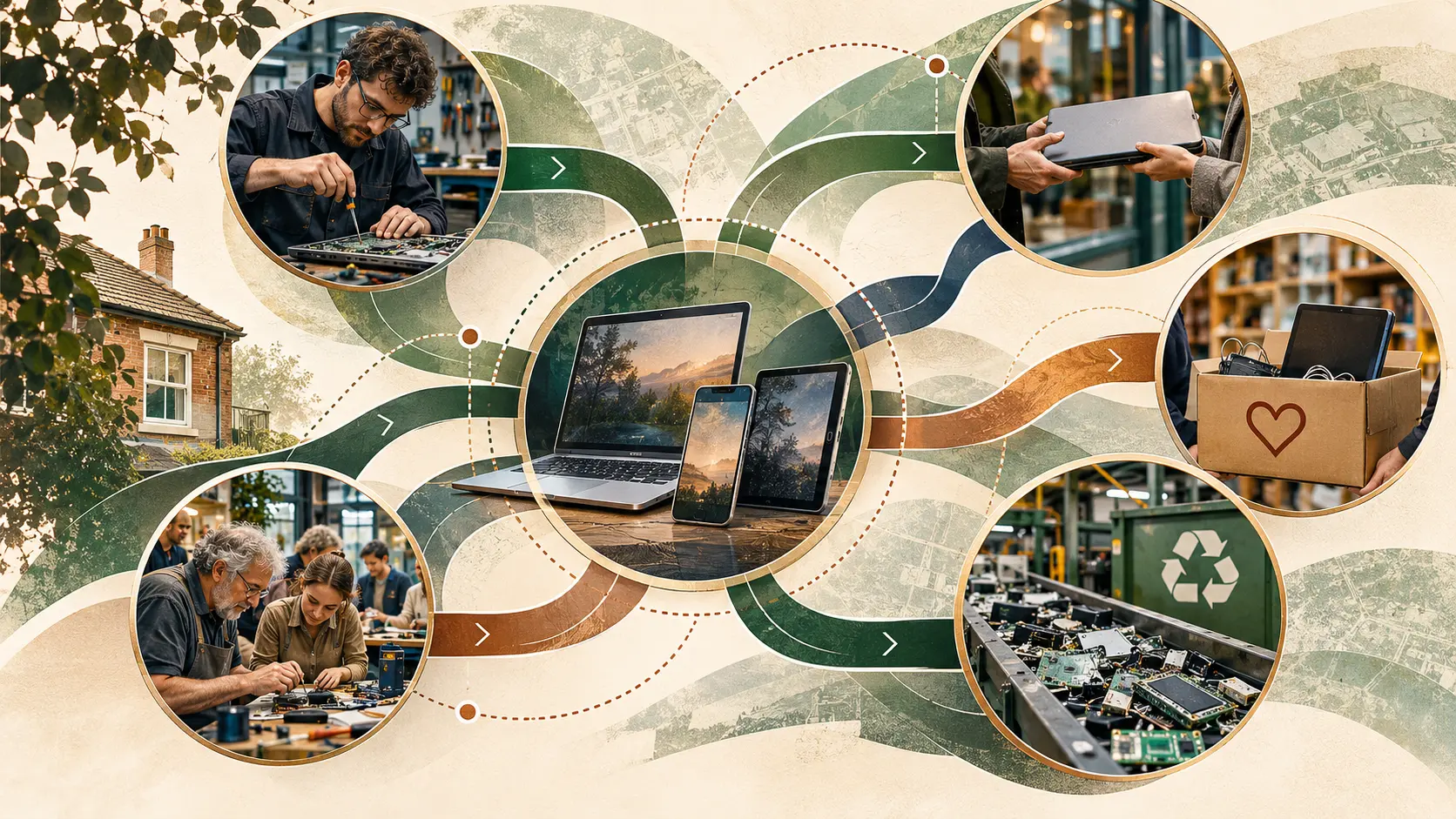
Acquisition, everyday use and a change in use can open multiple interconnected pathways. At what point does responsibility change?
Mobile phone · Household storage
A stored device may retain personal meaning, information or future usefulness. Storage is not necessarily the final stage of its journey.
Possible onward connectionsIllustrative conceptual model — not a research finding or a verified representation of actual material flows. Choices are not collected or stored.
Understanding how everyday activities are shaped by meanings, competencies, materials, routines and infrastructures.
Practices connect what people know and value with products, relationships and the services available to them.
Illustrative conceptual model — not a research finding or a verified representation of actual material flows. Choices are not collected or stored. These connected concepts remain subject to refinement through the literature review, academic supervision and empirical research.
A responsibility transition is a change in the relationship between an actor and responsibility. It does not necessarily mean that responsibility has been transferred to another actor.
Households ↔ services ↔ subsequent users
How do routines, household relationships and available options influence the capacity to act?
Responsibility may continue, be shared, be handed over or remain uncertain. Practical capacity, infrastructure and relationships connect these perspectives; this model does not assign obligations to any actor.
Illustrative conceptual model — not a research finding or a verified representation of actual material flows. Choices are not collected or stored.
Household consumer electronics in Norfolk.
Other small household electronic devices may be considered where relevant to participants’ experiences. Larger appliances, including televisions and washing machines, are currently outside the MSc scope.
Geographical illustration of Norfolk, UK. Intended rural and urban scope; no recruitment locations are confirmed.
The study considers products that may enter Waste Electrical and Electronic Equipment (WEEE) streams, while recognising that not all products leaving everyday use become waste.
The proposed study is designed for analytical depth, not statistical representation of Norfolk or the wider UK population.
Developing an evidence-based understanding of how householders in Norfolk manage electronic products at the end of everyday use.
Exploring responsibility boundaries and transitions embedded within social, material and institutional relationships.
Generating insights that may help organisations better understand household experiences, constraints and uncertainty.
Intended contributions, not established findings. The MSc does not seek to design, validate or implement a new responsibility governance framework.
Read the proposed methodologyBeyond the household
The journeys of electronic products connect households with a wider world of services, relationships and infrastructure.
Repair businesses, retailers, charities, reuse organisations, recyclers and local authorities may all influence what happens next. General professional and academic enquiries are distinct from formal research participation.